
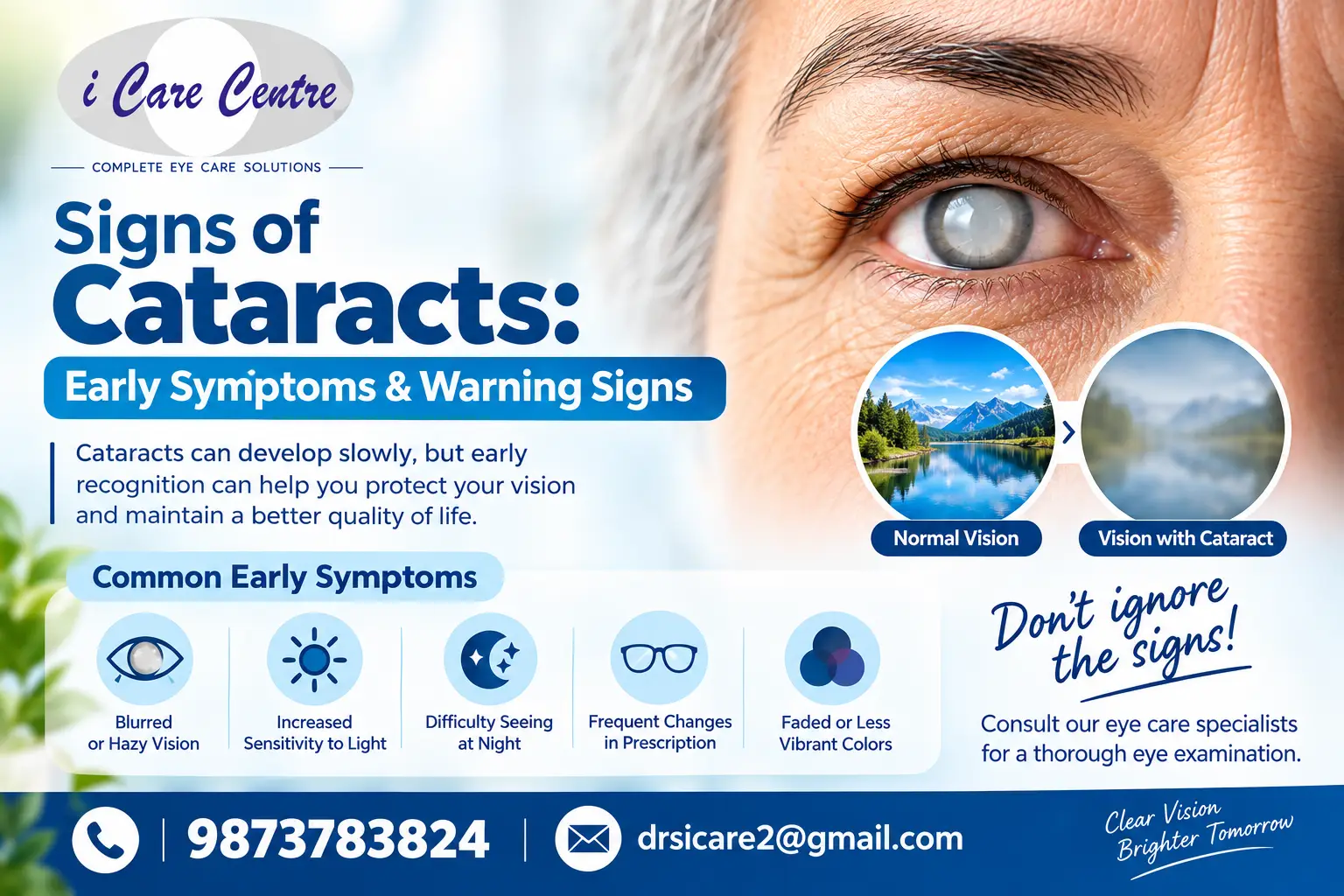
In the beginning, the changes may be subtle. You may notice that things look slightly blurred, colours appear less bright, or driving at night becomes more difficult. Some people simply assume that their eyesight is changing because of age or that they need a new pair of glasses. However, these changes can sometimes be associated with cataracts and should not be ignored.
Understanding the signs of cataracts can help you recognize changes in your vision and seek an eye examination at the right time. Early evaluation is especially important because other eye conditions can cause similar symptoms, and only a comprehensive eye examination can determine the underlying cause.
What Is a Cataract?
A cataract occurs when the normally clear natural lens of the eye becomes cloudy. The lens helps focus light onto the retina, allowing the brain to form a clear image. As the lens becomes less transparent, vision can gradually become cloudy or blurred.
Cataracts commonly develop with age, although they can also be associated with conditions such as diabetes, previous eye injuries, certain medications, or other eye-related factors.
The early signs of cataracts may not interfere significantly with daily activities at first. Over time, however, vision changes can become more noticeable and may affect reading, driving, recognizing faces, working, or seeing in low-light conditions.
What Are the Early Signs of Cataracts?
Recognizing the beginning signs of cataracts can help you decide when to schedule an eye examination. Some common symptoms include:
1. Blurred or Cloudy Vision
One of the most common signs of cataracts is gradually blurred or cloudy vision. Objects may not appear as sharp as they once did, even when you are wearing your usual glasses.
The blurring may initially be mild and can become more noticeable as the cataract progresses.
2. Increased Sensitivity to Light
Bright sunlight, headlights, or strong indoor lighting may become uncomfortable. Some people experience increased glare while driving at night or when looking toward bright lights.
3. Difficulty Seeing at Night
Another common symptom is reduced vision in dim lighting. Reading in low light or driving after dark may become increasingly challenging.
Night-time glare and halos around lights can also occur.
4. Faded or Yellowish Colours
Cataracts can affect the way colours appear. You may notice that colours look less vivid, duller, or slightly yellow compared with how you remember them.
This change can happen gradually, making it difficult to recognize until one eye is compared with the other.
5. Frequent Changes in Glasses Prescription
If your spectacle prescription seems to change more frequently than usual, it may be worth having a complete eye examination.
Although a prescription change does not automatically mean that you have a cataract, it can be one of several symptoms that deserves evaluation.
6. Halos Around Lights
Some people with cataracts notice rings or halos around headlights, lamps, and other bright light sources. This can be particularly noticeable at night.
If glare or halos interfere with driving or other everyday activities, consult an eye specialist.
7. Double Vision in One Eye
Cataracts can sometimes cause double or multiple images in one eye. However, double vision can have many possible causes, so it should not automatically be attributed to cataracts.
A professional eye examination can help identify the reason for the symptom.
What Are the Signs and Symptoms of Cataracts?
The sign symptoms of cataract can vary from person to person. Common changes may include:
- Blurred or cloudy vision
- Difficulty seeing at night
- Increased glare or light sensitivity
- Halos around lights
- Faded or yellowish colours
- Frequent changes in spectacle prescription
- Difficulty reading or seeing fine details
- Reduced ability to perform activities that require clear vision
These symptoms usually develop gradually. If vision suddenly becomes significantly worse, you should seek prompt medical attention because sudden vision loss may have causes other than cataracts.
What Is the First Sign of Cataracts?
For many people, the first noticeable sign is gradually blurred or cloudy vision. However, there is no single first symptom that occurs in every patient.
Some people may initially notice difficulty with night driving, increased glare, faded colours, or frequent changes in their glasses prescription.
Because early cataracts can produce subtle symptoms, regular comprehensive eye examinations are useful, particularly for older adults and people with risk factors for eye disease.
When Should You See an Eye Specialist?
You should consider an eye examination if changes in your vision begin affecting everyday activities.
For example, if you are struggling to read, experiencing difficulty driving at night, noticing increased glare, or finding that your glasses no longer provide the same clarity, an eye examination can help determine whether cataracts or another eye condition is responsible.
It is also important not to self-diagnose based only on symptoms. Several eye conditions can cause blurred vision, glare, or difficulty seeing clearly.
How Is Cataract Surgery Performed?
When a cataract significantly affects vision and daily activities, an ophthalmologist may recommend cataract surgery after evaluating the eye and discussing the patient’s visual needs.
At i Care Centre Delhi, phacoemulsification is the primary cataract surgery technique listed by the centre. During this procedure, the cloudy natural lens is broken into smaller fragments using ultrasonic energy and removed from the eye. It is then replaced with an artificial intraocular lens, commonly called an IOL.
Before surgery, the patient undergoes an eye assessment and measurements that help the surgeon plan the procedure and select an appropriate intraocular lens. The exact surgical plan can vary depending on the patient’s eye health and individual requirements.
Modern cataract surgery is generally performed as a short procedure, and many patients can return home the same day when clinically appropriate. i Care Centre Delhi states that its patients are monitored after surgery and that many experience relatively rapid visual improvement.
What Are the 3 Types of Cataract Surgery?
People often search for the “three types of cataract surgery,” but cataract surgery is better understood by looking at the surgical techniques used to remove the cloudy lens.
Depending on the clinical situation, cataract removal may be performed using techniques such as:
- Phacoemulsification – A small-incision technique that uses ultrasonic energy to break up and remove the cloudy lens.
- Manual Small-Incision Cataract Surgery (MSICS) – A manual technique using a larger incision than standard phacoemulsification.
- Extracapsular Cataract Extraction (ECCE) – A technique in which the cloudy lens is removed through a larger incision.
The appropriate technique depends on factors such as the density of the cataract, eye health, available technology, and the surgeon’s clinical assessment. Patients should discuss the most suitable approach with their ophthalmologist rather than choosing a technique based only on its name.
How Is Cataract Surgery Done?
The basic objective of cataract surgery is to remove the cloudy natural lens and replace it with an artificial lens.
A typical treatment pathway involves:
Eye examination: The ophthalmologist evaluates the eye and checks the cataract along with overall eye health.
Pre-surgical measurements: Measurements help determine the appropriate intraocular lens and assist with surgical planning.
Lens removal: During phacoemulsification, the cloudy lens is broken into small fragments and removed.
IOL placement: An artificial intraocular lens is placed inside the eye to replace the natural lens.
Post-operative care: Patients receive instructions regarding eye drops, activities, follow-up appointments, and protection of the operated eye.
The exact process and recovery recommendations can differ depending on the patient’s condition and the surgeon’s advice.
Can Cataracts Be Prevented?
There is no guaranteed way to prevent every cataract, particularly age-related cataracts. However, maintaining overall eye health is important.
Protecting your eyes from excessive ultraviolet exposure, managing conditions such as diabetes, avoiding smoking, eating a balanced diet, and attending recommended eye examinations can support long-term eye health.
Most importantly, do not ignore gradual changes in vision. Early evaluation can help determine whether the changes are caused by cataracts or another eye condition.
Cataract Evaluation at i Care Centre Delhi
i Care Centre Delhi provides comprehensive eye care, including cataract surgery and eye examinations. The centre states that its approach combines experienced ophthalmologists, modern equipment, and individualized treatment planning. Its cataract service specifically includes phacoemulsification and post-operative care.
If you are noticing blurred vision, glare, difficulty seeing at night, faded colours, or other possible signs of cataracts, an eye examination can help identify the cause and determine whether treatment is required.
Conclusion
Cataracts often develop gradually, which is why recognizing the early signs of cataracts can be important for maintaining comfortable and functional vision. Blurred vision, glare, difficulty seeing at night, halos, faded colours, and frequent prescription changes can all be reasons to schedule an eye examination.
Cataract surgery may be considered when the condition begins interfering with everyday activities. Modern techniques such as phacoemulsification can remove the cloudy lens and replace it with an artificial intraocular lens, with the exact approach determined by the patient’s individual eye health and visual needs.
If you are experiencing possible cataract symptoms or noticing a gradual change in your eyesight, consult an experienced Ophthalmologist in Delhi for a comprehensive evaluation and personalized guidance about the next steps.